
Flexibility in editing your family tree
Real families are not drawn in straight lines. A cousin marries his cousin, a widow marries her late husband's brother, a grandfather has three wives, a father's name drops out between two generations. We designed editing in Nasayeb to hold all of this, without anyone being duplicated or lost.
Adding from the right place
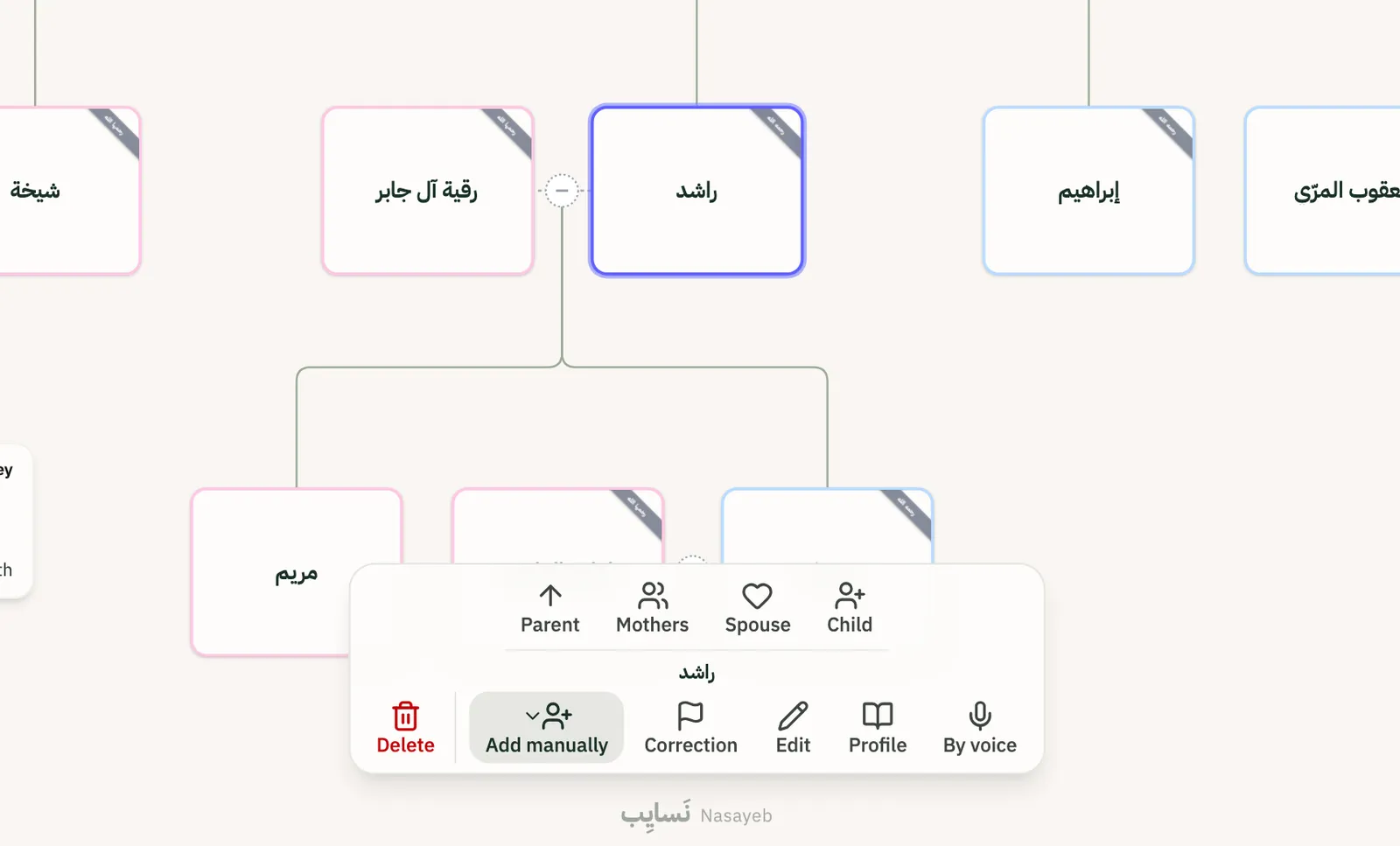
Press “Add manually” in the person bar and the add buttons appear above it: parent, mothers, spouse, son or daughter. Everything is added from the person, in their place in the tree. Keyboard lovers have shortcuts: E to edit, A for children, W for a wife, P for a parent.
From the tree, not a new copy
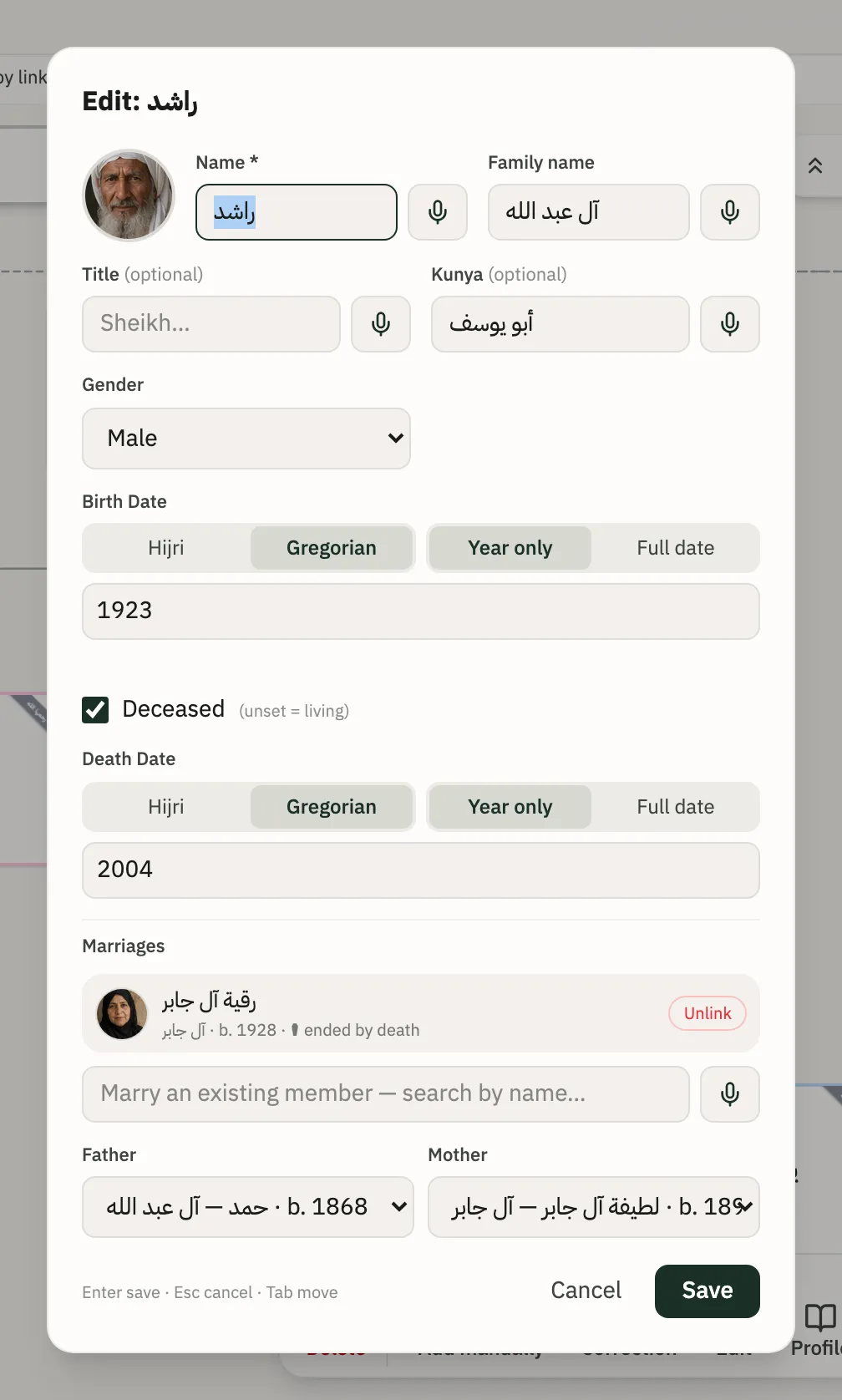
When a woman of the family marries a man of the family, there is no need to add her twice. In the marriage field, search for her by name and pick her from the tree: she becomes his wife while staying in her place under her father, and a reference card points to her from the other branch.
“Mother of all the children”
Often the wife is added after the children. In one save you can make a woman from the tree his wife and the mother of all his children, or share the children among his wives one by one. If she was recorded by mistake as someone else's wife, the wrong marriage is undone in the same save. Nasayeb refuses what cannot be right, such as marriage to a direct ancestor or descendant, or to a woman whose husband is still alive.
A father between two generations
Found out that “Muhammad son of Ali” is really “Muhammad son of Hasan son of Ali”? Insert the missing father between the two generations, and the whole branch moves under him unchanged.
Dates as we know them
Dates are Hijri or Gregorian, year only or a full date, because we often know “around 1330” but not the day. Marriages have a status, current, divorced, or ended by death, each drawn with its own line in the tree.
Nobody overwrites anybody
If two people edit the same person at the same moment, the second cannot silently wipe out the first: they are asked to reload the person and see what changed. And every save, however large, goes into the history and can be undone with one press.